 by Sylvain Duguay
We have all wondered, at some point or another, where we come from: which forces, events, people, and ideas have shaped the beings we are and the societies in which we evolve. Furthermore, we must wonder what brings us together as a group, and holds us together through time. Documentary films offer some answers to those questions as they carry forward in time traces of events past, as well as interpretations of great periods of history.
The Holocaust
Word War II has left profound scars on our civilization: the scope of the savagery committed, the unprecedented destructive power used by all sides, and the distress to which billions of people were subjected has defined how we perceive ourselves today. Two films explore very well the ins and outs of the conflict from different temporal perspective, looking at the rise of the Nazi party and the disaster of the Holocaust.
In Triumph of the Will (Germany, 1934, 110 min.), Leni Riefenstahl put her creative genius at the service of the Nazi party. Although she has always denied voluntarily creating a propaganda film, we are forced to acknowledge the incredibly convincing force of the film. Though a series of carefully selected events surrounding the Nazi party held in Nuremberg in 1934, the film shows us a country tightly united behind the rising force of the National-Socialist party. Opening on a scene showing Hitler coming down from the sky like a messianic figure, the film sets up the leader of the Nazi party as the leader-father of the wounded German nation. Every civilian is shown manifesting support for the party, and all the might of Germany is also shown to be at the disposition of the Fuhrer-to-be. This film was intended to rally the German nation and scare the possible foes of the nation. Looking at it from today’s vantage point is a chilling experience.
In Night and Fog (France, 1955, 31 min.), made 20 years later, Alain Resnais explores the consequences of the short-lived yet destructive Third Reich. This contemplative film, narrated by Jean Cayrol (himself a survivor of the camps), proposes an unforgiving look at the horrors perpetrated by Nazis in the their concentration camps. The archival footage, joined to images of the camps taken 10 years after the war, create a haunting picture of human tragedies lived in inhuman conditions. The film is about memory: who is left to remember? Is that past forever gone? How can we make sure not to repeat those events?
The film Shoah is a 10-hour documentary, based on interviews of survivors of the camps and archival footage,
that is one of the most important films ever made about the Holocaust.
Documentary films participate in the creation of a contemporary mythology by helping us understand the deep forces that shape our destiny. As we wonder what has shaped us as a collectivity, we turn to those films to show us the past in a way that offers answers to big metaphysical questions, and draw links to the human unconscious that drives our lives. Films like Triumph of the Will and Night and Fog help us make sense of the world in which we live, and provide us with some tools to understand our relationship to the world around us. Are we safe from such events repeating themselves? What is the nature of evil? Don’t we all bear a part of shadow within ourselves? And don’t we have a duty to bear the memories of those events? As we look at those past events, and as they are played back time and time again, we come to share a collective understanding of the past, and we develop a community of ideas that link us to one another.
Je Me Souviens
The political scene in Quebec is a complex one: French and English have had a strong presence in the province, and the traces of those two founding peoples are still at the center of the political, cultural, and ideological landscapes of the inhabitants of La Belle Province. The tensions between French-speaking and English-speaking Québécois are ever smoldering below the day-to-day accommodations made by both groups, but the nationalist aspirations of a part of the French-speaking population have shaped the political aspirations of the province for many decades.

In Action: The October Crisis of 1970 (Roby Spry, 1973, Canada, 87 min.), the events surrounding the kidnapping of James Cross (British trade commissioner) and Pierre Laporte (Québec minister) by the FLQ are documented through extensive archival research and informative voice-over. Explored in this film are the causes of the rise of nationalism in Québec, the violent actions of the FLQ, the unfolding of the crisis leading to the promulgation of the War-Measures Act by Prime Minister Trudeau and the subsequent assassination of Pierre Laporte, as well as the reactions of various people to the events. The film offers a striking (yet rather well-balanced) portrait of nationalism in Québec, and allows the viewer to grasp the complexity of Québec’s independence movement.
Je Me Souviens
The political scene in Quebec is a complex one: French and English have had a strong presence in the province, and the traces of those two founding peoples are still at the center of the political, cultural, and ideological landscapes of the inhabitants of La Belle Province. The tensions between French-speaking and English-speaking Québécois are ever smoldering below the day-to-day accommodations made by both groups, but the nationalist aspirations of a part of the French-speaking population have shaped the political aspirations of the province for many decades.
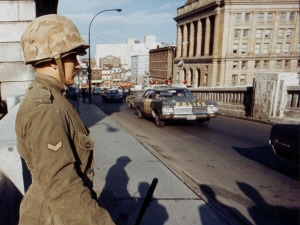
The CBC archives offer an interesting panorama of the October crisis through original clips from the era:
select the various clips from the right-hand side column.
In Comfort and Indifference (Denys Arcand, 1982, Canada, 108 min.), we are presented with a portrait of Québec on the eve and the aftermath of the 1980 referendum on the independence of Québec. Renowned filmmaker Denys Arcand takes the pulse of the province as it is asked to decide on its future. Using footage gathered by many filmmakers throughout the years, he highlights the main arguments for and against independence, presenting their main political supporters (although many of them are hard to recognize without proper identification, more than 30 years after the events), and showing a favorable bias for independence. This bias is mostly felt through the inclusion of the historical figure of Machiavelli, commenting on the actions of the government and comparing the tactics of the promoters of the “No” camp to his famous book of advice to rulers, “The Prince.”

The 1980 referendum as presented by the archives of Radio-Canada
Once again, those films play the role of myths by explaining to us, through two narratives central to the nationalist identity, how the Québécois political identities are rooted in conflict and attempts to determine their specificity. Knowing your roots is supposed to help you decide how to shape your future, and those films, by exposing many issues linked to the identity of the province, seek to create a foundation to answer some questions related to the political future of Québec. By helping us imagine what the nation should be, those movies are trying to help come together as a collectivity in order to shape the future of the province (or the country, depending of your allegiance). While nationalism can exclude the other in some of its more conservative forms, it is nevertheless essential to gather people around a common sense of identity. The films serve as fundamental tools to promote, discuss, and define the Québecois collective identity.
Looking Back, Looking Ahead
While there are many ways to learn about our past, either by taking history courses, listening to people recount the events they experienced first-hand, or conducting in-depth research on a topic related to our past, documentary films offer a unique opportunity to reach out to a time that is forever gone. The Holocaust has redefined our understanding of evil, and struck a blow to our pride of being at a “civilized” stage of the evolution of our species. We must learn to recognize manipulation and propaganda when it is aimed at us, and we must accept to confront the consequences of the actions of our fellow human beings. And while the rise of nationalism in Québec is more focused on the history of our country, it is nevertheless essential to understand the roots of the various political ideologies (and corresponding parties) that are part of today’s political life in the province. Only when we look back at the past can we understand the present and look ahead to the future.
Yet those films reflect a past forever gone and inaccessible: the march of time, rushing forward in the name of progress, tends to blur our vision of the past. Who get to write the past? How accurate are the representations reaching us through the years? Can we really understand what has happened from our position, solidly anchored in the present as we are? As time goes by, some meanings attached to those stories are forever lost or distorted. This is the fate of all myths are they are carried through time: they are reinterpreted and reinvented according to the needs and the worldviews of the eras through which they are carried.
By making extensive use of archival footage, those films try to capture a sense of the past as it was happening. While Leni Riefenstahl had the opportunity to document the events as they unfolded (and shape them according to her vision), the other filmmakers had to use images taken from newsreels, various news services, archives, as well as footage recorded by other filmmakers. Although the narration often guides our reading of those images, there remains a sense of immediacy and truth to the unaltered images reaching us through time. We may want to ignore the horrors and troubles of the past, yet they find a way to reach out to us.
The Internet Archive is a website with the mission of collecting all sorts of media
and make them available to the wider population
As we navigate the political landscape, we are asked to make decisions. When we vote in elections, we must take into account the history and the development of the identities to which we belong. And on a more global scale, as we look at the history of our species as it spreads over the centuries and across the planet, we must ask ourselves how we relate and react to the constant repetitions of the bloody conflicts that have plagued us since times immemorial. As a Montrealer, a Québécois, and a Canadian, as well as a global citizen of the Earth, I must constantly redefine my position to the world that surrounds me, as everyone must do. We belong together, and we must constantly learn to live as a collectivity.
Stories About Ourselves
Mythology has a way to travel untouched through ages and civilizations, bringing forth a sense of connection with the previous generations of humans that preceded us. Those stories have taken many forms, and today it seems that documentary films offer us a mirror through which we can look back in time, only to realize that very little has changed. We tend to think of ourselves as independent, free-willing beings, yet we are inescapably trapped in the folds of history, carried forward on the waves set in motion by generations of humans who lived, loved, and died just like we do. A humbling thought, maybe, but it is also joined to a sense of shared evolution, and hopefully, to a desire to become a better people.


George Santayana once said “Those who cannot remember the past are condemned to repeat it”. Unfortunately, it’s human nature to make mistakes, yet mistakes the size of the Holocaust as seen in Night and Fog is a mistake of ignorance. Had we remembered previous atrocities committed by humankind, this wouldn't have destroyed as much as it had. Action: The October Crisis of 1970 gives us another example of ignorance, unfortunately people resorted to violence to try and achieve what they wanted and it didn't turn out too well. As a history enthusiast I really enjoyed Triumph of the Will, Night and Fog and Action: the October Crisis of 1970, they intrigued me as to how we can make so many mistakes and never learn from them.
ReplyDelete-Philippe C.
In "Night and Fog" the narration by Jean Cayrol a holocaust survivor truly brings the emotion into the picture. Through the voice over we feel and take far more than if the videos were shown alone. The Documentary film delivered the scale tragedies that were experienced by the members of concentration camps. This film not only left me shocked but also disappointed to know such things could happen. We must never forget the holocaust, nor the millions of lives that were taken from innocent people due to their ideologies, religion, and ethnicity to which they supported. This film was full of raw footage and that is the only way the holocaust should be depicted so that we not only learn, but never forget the horrific tragedies it amounted to. -Timothy Bailey
ReplyDelete"We should regret our mistakes and learn from them, but never carry them forward into the future with us."
-Lucy Maud Montgomery
I thought that these films were very interesting. It was very shocking that everything shown in “Night and Fog” actually happened. It was also shocking how much propaganda the Nazi’s used. I think it’s important to remember these kinds of events because we need to learn from them. By remembering we can prevent these types of things from happening because we are able to see how tragic these events really were. However, sometimes we don’t learn from our mistakes, which is evident in “Action: The October Crisis of 1907” where people resorted to violence to try to get their way.
ReplyDelete- Sereena